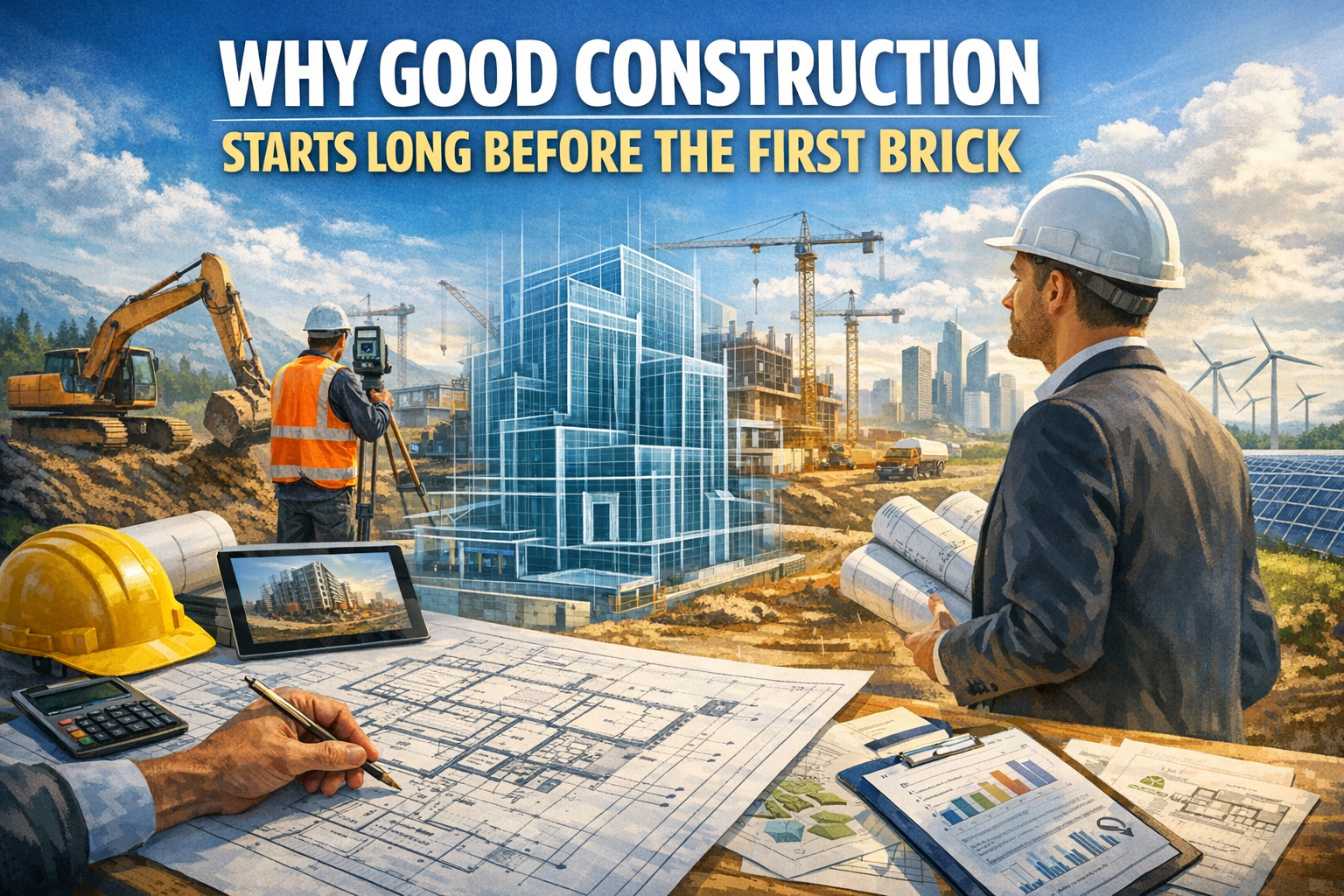
Why Good Construction Starts Long Before the First Brick
You can tell a lot about a building long before anything appears on site. Sometimes you see a project move smoothly, almost quietly, and other times everything feels tense from the start. That difference usually comes down to why good construction starts long before the first brick is ever placed.
The Stage No One Sees
There’s a period where nothing physical happens, yet most of the future problems are already being decided. It doesn’t look important from the outside. No cranes, no noise — just plans, discussions, revisions.
But this is where the structure actually begins.
At this stage, the project is still flexible. You can adjust proportions, rethink layouts, question assumptions. Once construction starts, those same changes become expensive, complicated, sometimes impossible.
And that’s the quiet truth: it’s easier to solve a problem before it exists than after it shows up.
When Decisions Are Made Too Late
It’s not unusual for projects to move forward while still carrying uncertainty. Everything seems “good enough” to begin. The idea is that details can be refined along the way.
That sounds practical. It rarely is.
Because once work begins, decisions don’t disappear — they shift into a different form. Instead of being thoughtful, they become reactive.
You start seeing things like:
- adjustments made directly on site instead of earlier
- solutions that fix one issue but create another
- small compromises that stack over time
None of these feel critical in the moment. But they shape the final result more than people expect.
Understanding the Site Changes Everything
Every location has its own behavior. Not just visually, but structurally — how the ground responds, how moisture moves, how temperature shifts affect materials.
Ignoring that, even slightly, creates tension in the building from the beginning.
Some projects adapt to their environment. Others try to impose a design without fully accounting for it. The difference becomes visible later, often in ways that are hard to trace back.
It’s rarely about one big mistake. More like a series of small mismatches between the design and the reality it sits in.
Coordination Before Construction Feels Invisible
There’s another layer that doesn’t get much attention — how well everything is aligned before work starts. Not just drawings, but people, expectations, timing.
If that alignment isn’t clear early, it doesn’t magically fix itself later.
Instead, it shows up during construction as hesitation, rework, or constant clarification. Work continues, but not smoothly. There’s always a slight friction underneath.
And once that friction appears, it tends to stay.
Why the Beginning Isn’t Really the Beginning
It’s easy to think construction begins when materials arrive and work becomes visible. In reality, that’s just the execution of decisions made earlier.
By that point, the direction is already set.
That’s why why good construction starts long before the first brick isn’t just an idea — it’s a practical observation. The quality of what comes later depends heavily on what was resolved before anything physical existed.
Closing Thought
When a project feels stable from start to finish, it’s rarely because everything went perfectly during construction. More often, it’s because the difficult parts were handled before they could become visible problems.
And that part doesn’t leave obvious traces.
Because in the end, why good construction starts long before the first brick is less about preparation as a concept, and more about how much of the future was quietly decided before anyone even noticed the project had begun.