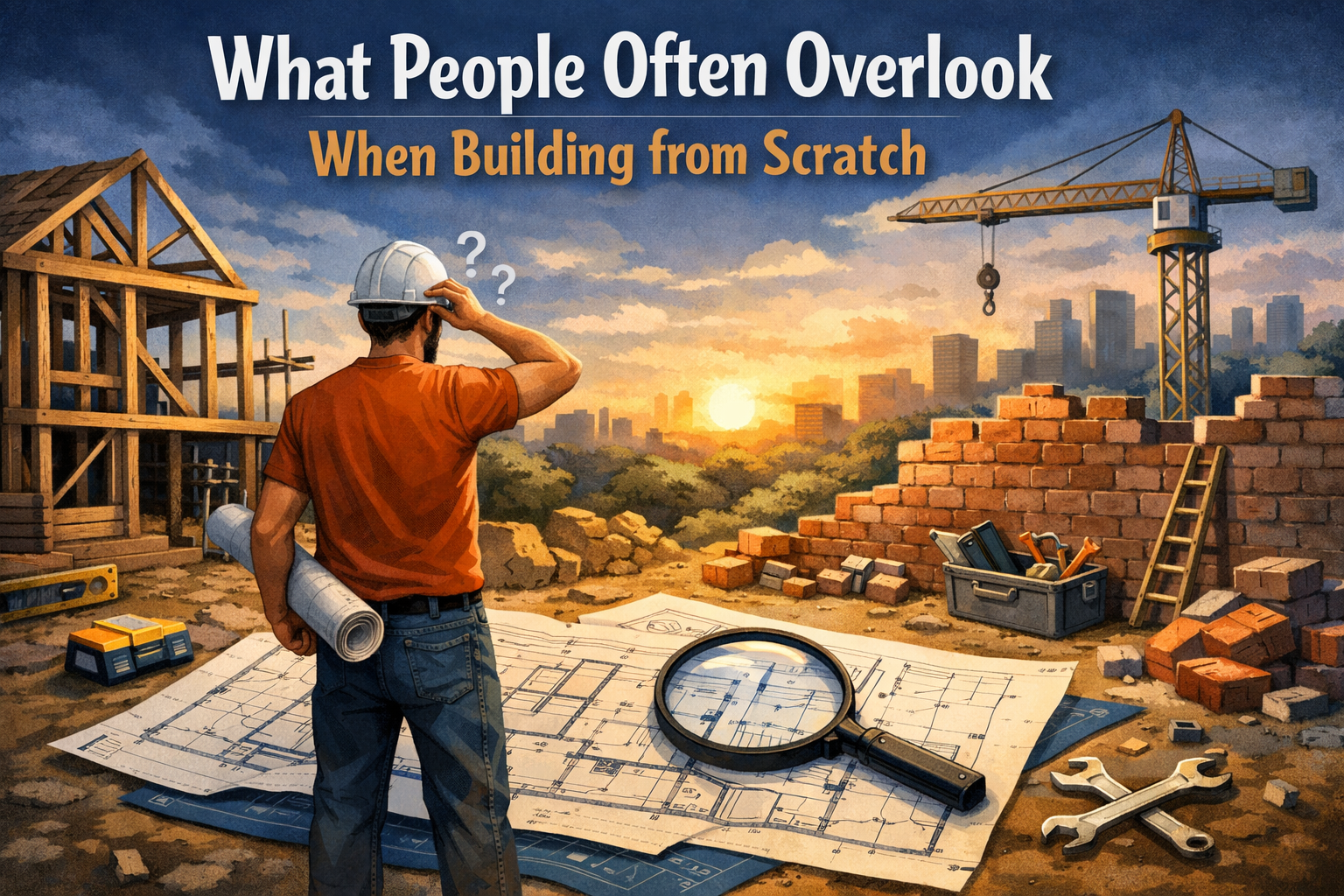
What People Often Overlook When Building from Scratch
When people start building, attention usually goes to what can be seen — layout, size, appearance. It feels logical. But somewhere along the way, what people often overlook when building from scratch begins to shape the outcome much more than those visible choices.
It’s Not Just About the Plan
At first, the plan looks complete. Everything is drawn, measured, approved. There’s a sense that the hardest part is done.
But a plan is still an assumption.
Once work begins, reality starts interacting with those decisions. Slight differences appear. Something that looked fine on paper feels awkward in space. A detail that seemed minor becomes inconvenient when used every day.
This is where things quietly shift.
People rarely overlook the big elements — they overlook how those elements connect. The transitions between spaces. The way movement flows. The small distances that feel different in real life than they did in drawings.
Small Choices That Stay Forever
There’s a strange pattern in building projects. The decisions that seem least important tend to last the longest.
You don’t notice them during construction. You don’t even think about them when everything is new. But over time, they become part of daily experience.
It might be something as simple as:
- how light enters at certain hours
- where you naturally stop when moving through a space
- how comfortable it feels to stay in one area longer than expected
These are not dramatic design features. They’re quiet details. And yet they define whether a place feels easy to live in or slightly uncomfortable without a clear reason.
When Convenience Is Decided Too Early
There’s also a tendency to simplify decisions too quickly. To choose what seems practical at the moment, without thinking about how it will feel later.
It makes sense during the process. You want to move forward.
But convenience during construction doesn’t always translate into comfort after.
Some compromises are invisible at first:
- placing something “just slightly” off to avoid rework
- choosing a quicker solution instead of a better-fitting one
- assuming a detail won’t matter in daily use
Those decisions don’t cause immediate problems. They create small, repeating inconveniences that become noticeable only after living in the space.
The Gap Between Building and Living
There’s a difference between constructing something and actually using it. It sounds obvious, but it’s easy to ignore while everything is still in progress.
During construction, the focus is on completion. On getting things done.
But living in a space reveals a different perspective. You begin to notice how it supports — or doesn’t support — your routine. Whether it feels natural or slightly forced.
And this is where what people often overlook when building from scratch becomes clear. Not during the process, but after it’s finished.
Because the building doesn’t stay a project. It becomes part of everyday life.
Closing Thought
It’s easy to focus on what looks right and assume everything else will follow. Most of the time, it doesn’t.
The things that matter most are often the ones no one stops to question. They’re small, quiet, and easy to move past during construction.
And yet, what people often overlook when building from scratch is exactly what stays with you long after the work is done — not as a problem, but as a feeling you either notice… or don’t.