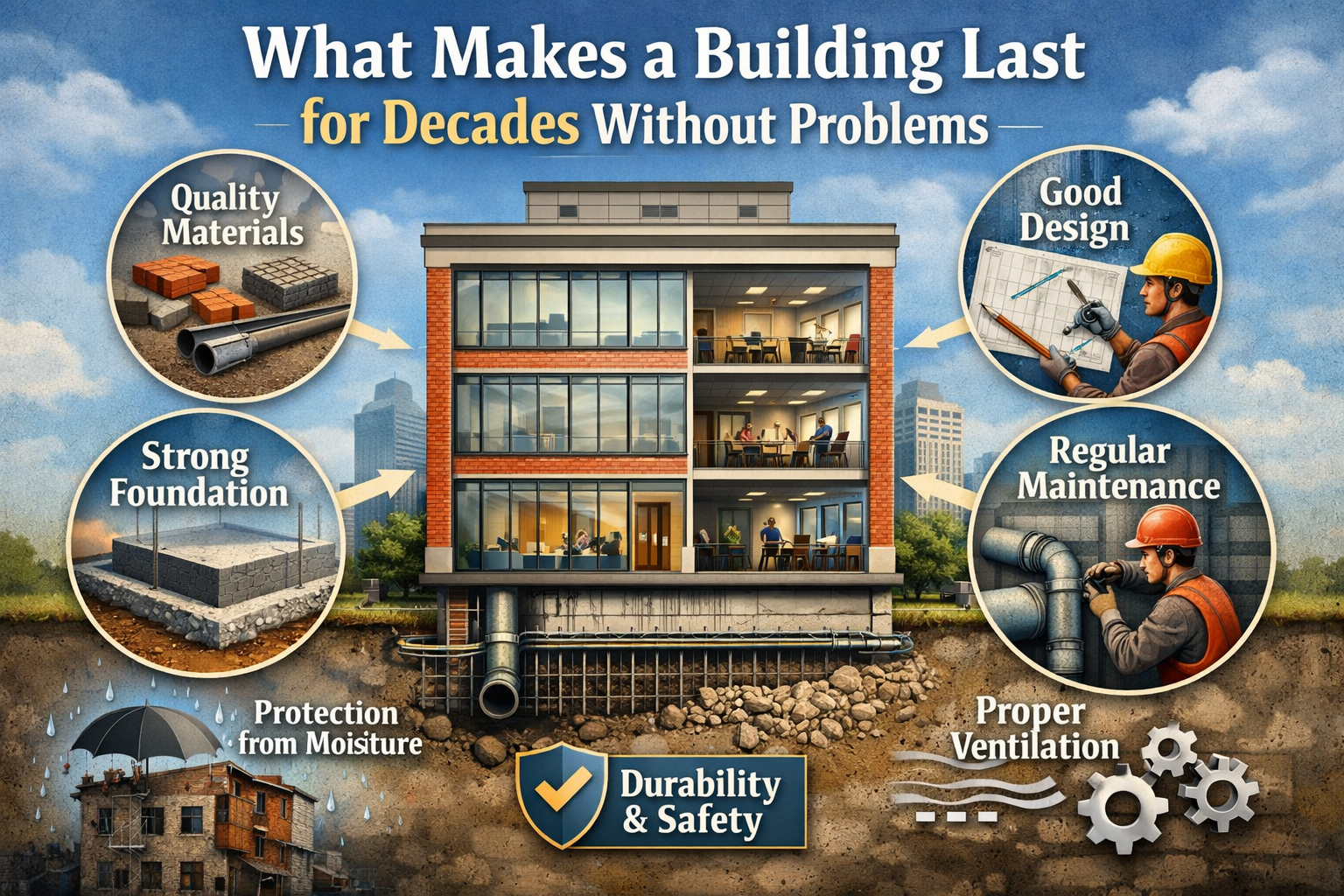
What Makes a Building Last for Decades Without Problems
You can stand in front of two buildings built around the same time, and they’ll feel completely different. One looks settled, almost calm. The other already shows signs of stress. That’s where what makes a building last for decades without problems stops being a theory and becomes something you can actually see.
It Starts Long Before Anything Is Built
There’s a quiet phase most people never think about. No walls, no structure yet — just decisions. And oddly enough, this is where durability is either built in or slowly compromised.
It’s not about choosing “the best” materials in a simple sense. It’s about how everything is expected to work together over time. Loads, moisture, temperature shifts — none of it dramatic on its own, but all of it constant.
When this stage is rushed, the consequences don’t appear immediately. They wait.
And what gets overlooked is usually simple:
- how the building will handle small movements
- where stress naturally accumulates
- how different materials react next to each other
Those aren’t visible during construction. But they define what happens years later.
The Difference You Notice Without Knowing Why
Sometimes you walk into a building and nothing draws attention. Not in a boring way — more like everything feels stable without asking for it.
Other times, you notice small discomforts you can’t quite explain. A door that feels slightly off. A floor that doesn’t sound solid. It’s subtle, but it builds a kind of tension.
That contrast isn’t random.
It often comes down to how carefully things were aligned, adjusted, and checked in moments that didn’t seem critical at the time. A few millimeters here, a small correction there. Individually insignificant. Together, they either create stability or slowly erode it.
Time Doesn’t Break Buildings — Patterns Do
There’s a common assumption that buildings “wear out.” That time is the main cause.
But if you look closer, time just reveals patterns that were already there.
A structure doesn’t fail because it’s old. It reacts to repeated stress, to small imbalances that were never fully addressed. And once those patterns start, they rarely stay small.
It often follows a familiar sequence:
- a minor imperfection appears
- it begins to repeat under normal use
- surrounding elements adjust to compensate
Nothing dramatic happens at once. That’s the tricky part.
Maintenance Isn’t Always About Repair
There’s this idea that long-lasting buildings simply get maintained better. That’s partly true, but it misses something important.
Good maintenance doesn’t fight the building. It works with how it was originally designed to behave.
When the structure is well thought out, small interventions stay small. You fix something, and it stays fixed. When it’s not, even minor repairs feel temporary.
That’s why what makes a building last for decades without problems isn’t just about construction itself. It’s about how predictable the building remains over time.
Closing Thought
You rarely notice the buildings that last. They don’t demand attention, don’t create constant small issues, don’t force you to think about them.
And maybe that’s the point.
Because in the end, what makes a building last for decades without problems isn’t something obvious or impressive. It’s the absence of things going wrong — quietly, consistently, year after year.