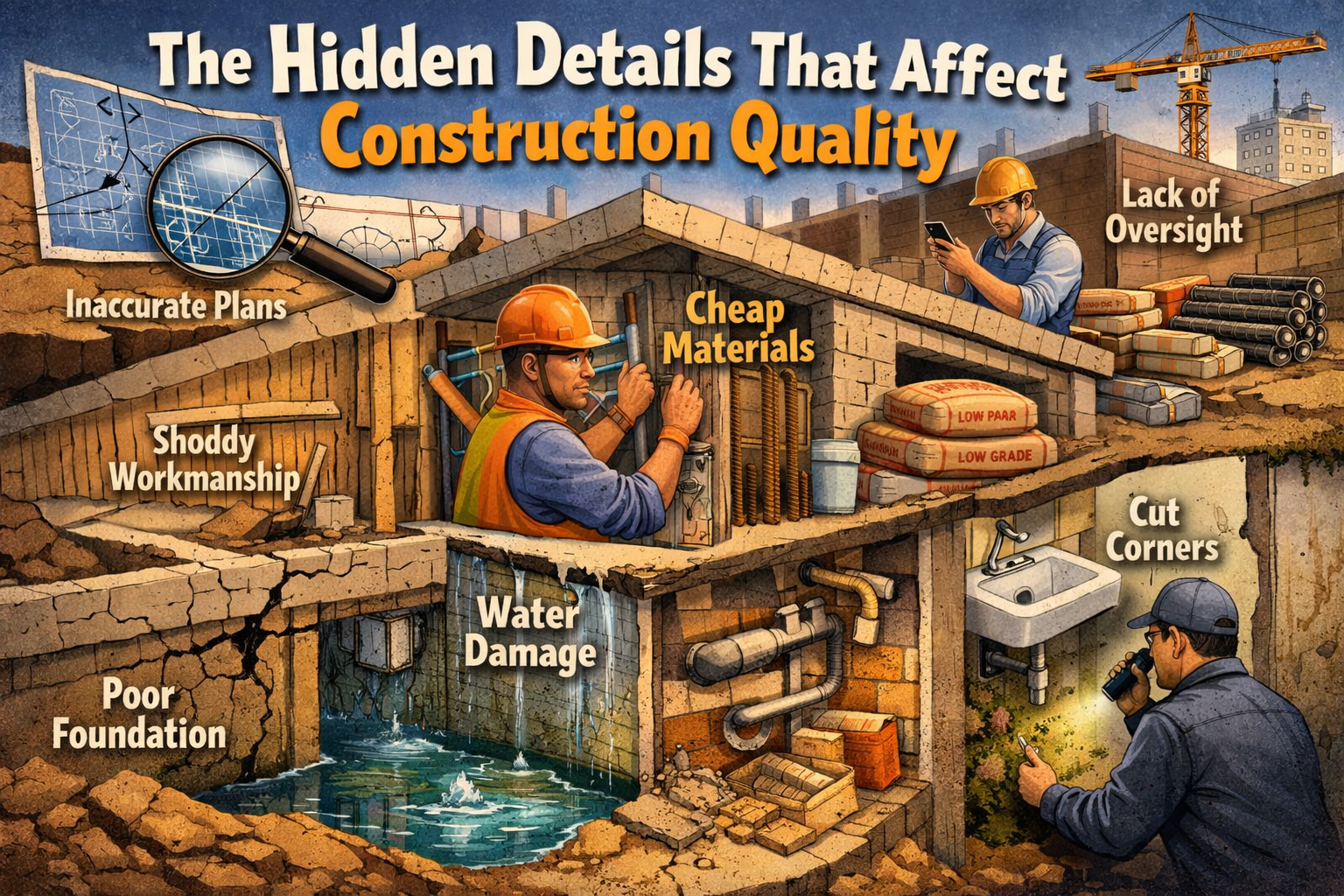
The Hidden Details That Affect Construction Quality
You can walk through a finished building and everything might look clean, aligned, and complete. Still, something feels either solid… or slightly off. That’s usually where the hidden details that affect construction quality start to matter — not in what you see first, but in what you never notice directly.
Precision Lives in the Background
Most visible elements get attention. Straight lines, smooth surfaces, neat finishes. They’re easy to evaluate.
But quality doesn’t come from what’s obvious.
It comes from the parts no one checks visually once they’re covered. The alignment beneath the surface. The way different layers meet. The small tolerances that don’t stand out but hold everything together.
What’s interesting is how little these details seem to matter during construction. A millimeter here, a slight deviation there. It feels acceptable.
Until those tiny differences start interacting.
When “Almost Right” Becomes Noticeable
There’s a point where a building stops being judged by its appearance and starts being experienced through use. That’s when small inaccuracies become visible in unexpected ways.
Not dramatic failures. Just small, persistent signals.
A door that needs a bit more pressure. A surface that reflects light unevenly. A joint that draws attention for no clear reason. These are not major defects, yet they change how the space feels.
It often comes down to details that were technically within acceptable limits:
- slight misalignments between elements
- uneven transitions hidden under finishes
- tolerances that stack instead of canceling each other
Individually, they pass. Together, they create tension.
The Way Elements Connect Matters More Than the Elements Themselves
It’s easy to focus on materials, components, systems. Choosing the right ones feels like the key.
But connections define behavior.
How one part meets another. How loads transfer. How movement is absorbed or restricted. These interactions don’t appear in isolation — they form a network.
And that network either distributes stress smoothly… or concentrates it.
This is where the hidden details that affect construction quality become structural, not cosmetic. Because problems rarely start in the middle of a component. They start at the edges, where things meet.
The Quiet Influence of Repetition
Construction isn’t just about one detail done right. It’s about the same detail repeated dozens, sometimes hundreds of times.
Consistency becomes more important than perfection.
A single precise alignment doesn’t define quality. Repeating that alignment across the entire structure does. And that’s where small variations begin to matter more than expected.
You see it over time:
- one repeated detail slightly off in multiple places
- a pattern that shifts just enough to become visible
- a rhythm that feels inconsistent without a clear reason
The building doesn’t fail. But it loses that sense of quiet stability.
Closing Thought
What’s interesting is that most of these details never get attention once the building is complete. They disappear behind finishes, under surfaces, inside structures.
And yet they define everything.
Because in the end, the hidden details that affect construction quality don’t need to be seen to be felt. They show up in how a space behaves — and whether it feels effortless… or not.