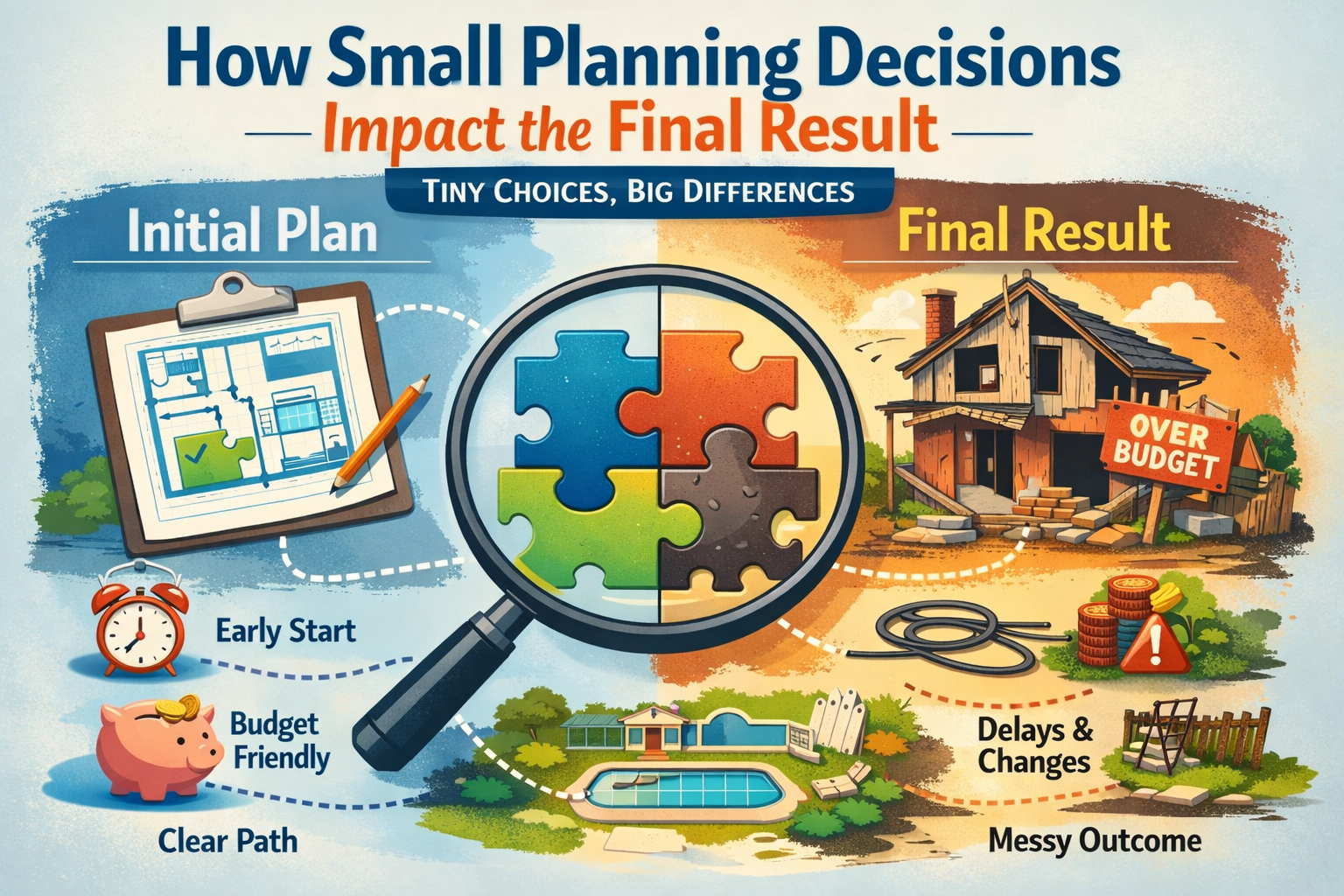
How Small Planning Decisions Impact the Final Result
At the beginning, most choices feel minor. You adjust something slightly, shift a dimension, move a detail just a bit. It seems harmless. But over time, how small planning decisions impact the final result becomes impossible to ignore — not because of big mistakes, but because of how those small choices accumulate.
It Rarely Feels Important at the Time
Planning doesn’t feel dramatic. There’s no visible outcome yet, just conversations, sketches, adjustments. You make dozens of decisions in a single day, most of them without hesitation.
That’s where the problem hides.
A small change feels safe because it doesn’t break anything immediately. Moving a wall slightly. Reducing a gap. Simplifying a detail. Each one makes sense on its own.
But they don’t stay isolated.
What’s easy to miss is how these decisions interact. One adjustment shifts another. A small compromise leads to another small correction. And suddenly the project starts drifting away from what it was supposed to feel like.
When Everything Looks Right but Feels Off
There’s a moment that’s hard to explain. The building is finished, everything is technically correct, yet something doesn’t sit quite right.
Not wrong. Just… off.
You notice it in subtle ways. Movement through the space isn’t as smooth as expected. Light doesn’t behave quite how you imagined. Certain areas feel tighter or more awkward than they should.
It often comes down to details that seemed insignificant earlier:
- distances that are slightly shorter than comfortable
- alignments that are just a bit inconsistent
- transitions between spaces that weren’t fully considered
None of these would stand out during planning. Together, they define the experience.
Small Corrections During Planning vs After
There’s a big difference between adjusting something early and fixing it later. During planning, changes are light. Flexible. Almost invisible.
After construction starts, the same change becomes heavier.
You can feel it in the way decisions are made. Earlier, it’s about improving. Later, it’s about adapting. And those are not the same thing.
People often underestimate this shift. They assume details can be refined at any stage. Technically, yes. But each stage adds resistance.
That’s why how small planning decisions impact the final result is less about the size of the decision and more about when it’s made.
The Quiet Build-Up of Consequences
Nothing dramatic needs to go wrong for a project to feel different from what was intended. It’s usually a slow build-up.
One decision makes the next one slightly harder. Another adds a small constraint. Over time, flexibility disappears, replaced by adjustments that keep things moving but not necessarily improving.
It’s rarely one big turning point. More like a gradual narrowing of options.
And once that happens, the final result reflects not the original idea, but the path taken to get there.
Closing Thought
The strange part is that most of these decisions don’t feel important when they’re made. They feel practical, reasonable, even necessary.
Only later do they become visible — not as mistakes, but as differences.
And that’s really what it comes down to. Because in the end, how small planning decisions impact the final result isn’t about individual choices. It’s about how those choices quietly shape everything that follows.